Radical Matters - Editions / Label | SG
Presents the hermetic multidimensional concept album
"CHTHONIAN MUSIC" :
Music composed, played and directed by K11 Pietro Riparbelli
Concept, ideation, site specific project direction, screenplay, score, texts, lyrics, sigils and design of the editions: RM-ED/L | Sandro Gronchi. 2 channels and multi channel audio composition, performing, mixing, mastering and real-time spatialization processing by Pietro Riparbelli. Acoustic installation by Sandro Gronchi and Pietro Riparbelli. Recording sessions: Francisco López, Christina Kubisch, Massimo Bartolini, Seth Cluett, Y.E.R.M.O., Francesco Brasini / Seven Guitars, Luciano Maggiore, Gianluca Becuzzi, Andrea Marutti, Philippe Petit , Deadwood, Burial Hex, Aderlating, Utarm, Nordvargr, L'Acephale. This conceptual album is a 2 channel stereo hi-fi transposition of a related site specific multi-channel acoustic installation set, based on the sound spatialization system I.M.E.A.S.Y, both developped from the hermetic multidimensional sound art project Chthonian Music, conceived by RMEDL to be performed in an ancient Etruscan hypogeum sited in Cecina (Italy), during the spring solstice (Ante Diem Duodecimum Kalendas Apriles) within the programmatic-conceptual event "Metasound – Independent Curatorial Experiences in ntemporary Art: from the object up to the event: sound art, multimedia and practice of the art of listening",an hypermedial site-specific project, cured by SG as RMEDL, installed within the archaeological park of Cecina, in the core of the ancient Tuscia.
This conceptual album and the related audio installation are musically composed by Pietro Riparbelli / K11 who playing organ, voices, drum and directis the recording sessions of the acoustic sources produced by the previous mentioned artists, expecially conceived by the authors for this project. This multidimensional collaborative opera is a bridge between the conception of sound within the contemporary art scene, the postindustrial culture and the avantgarde black metal musical scene, focusing on creating a dialogic development between radical forms of concrete music, unorthodox sounds, conceptual arts and experimental recordings practices of the acoustic phenomenas.This project is based on the study of the territory where Cecina stands today, already known in Etruscan age with the name of Kaikne or Kaikna and was inhabited in Roman times, when an imperial personality, the consul Albino Cecina who was a descendant of an ancient Etruscan family that came from Volterra (Velathri), ordered the construction of a villa, the ruins of which are still visited in San Vincenzino.
The surrounding area of Cecina, knew a long period of decline, which began with the decline of the Etruscan civilization and marked during the Roman domination. However in medieval times the name of the Tuscan town was quoted by Dante Alighieri (Inf. XIII, 7). The peculiar state of re-veiling of the historical roots of Cecina town, began in the Roman construction plant of the Albini Villa by the department of archaeological sciences of the University of Pisa (in this contest stands the discovery of a headless statue in Egyptian alabaster that represents Isis). It becomes the right condition for the staging of meta-curator project Metasound through which a witness is shown, though as a part of a state of the art research on aesthetic trans-operative promoting by RM-ED/L. The choice of the roman cistern and its adjacent mysteric tunnels, as the core of the catabasis experience intrinsec in the concept of Chthonian Music. and as sound-chamber of the related acoustic installation, comes from the study on the symbolic meaning of places of worship, that was developed in Etruscan age - civilization that first settled in the adjacent grounds to the Cecina river. The re-veiling of the etruscan settlement, roman villa and medioeval cemetery, in the small park of San Vincenzino, opens to the possibility of considering the reading of the archaeological sites in their likely original function of sacred hypogeum. The cavity of the cistern, thus, becomes a possible reuse of an earlier site of Etruscan origine, with a more likely symbolic function of a place consecrated to the worship of Chthonic Deities. Demeter-Persephone (Phersipnai) was the goddess which was based the religion of the Mysteries, imported by the Etruscans in Italy.
Kidnapped by Hades and carried in the realm of the underworld, becaming the queen of the hell through his ritual death. Demeter, the goddess of the earth got that Persephone / Phersipnai reigned during the winter months and in the remaining months could return to earth, whose myth is the awakening of the soul and its cyclical path of death and transfiguration. Delving into the dark recesses of the earth, meant to open a gate to a supernatural dimension. Tunnels and mazes of paths represented the symbolic difficult journey of the soul towards a higher life. Exit from the bowels of the land, from the darkest recesses of the earth and the human soul, represents the rebirth of the soul to a higher level of living. The annual return of Phersipnai on earth among the living, coincided with the beginning of spring, and on this occasion were celebrated the Lesser Mysteries, or the second Birth. On this occasion, wizards with snakes twisted on the arms, moved at the flickering light of torches in long orgiastic processions (Nuktélia) that ended with a search of the queen Phersipnai.Hetrvria Hermetica.
Audio Score:
Score:
I - Mvndvs [Munth] Francisco Lopez - field recording, acousmatic re-processing. Seth Cluett - deep low frequencies sounds Pietro Riparbelli - distorted organ, mixing
II - Katábasis
pt.I Christina Kubisch - tuning forks, electromagnetic filtered
sounds recorded with an inductiveheadphone system, cello flageolett. Francesco Brasini / Sevenguitars - guitars, amplifiers, enviromental feedbacks Pietro Riparbelli - organ, composition
pt.II L'Acephale - guitar, drum, voice Utarm - power electronics, drones Pietro Riparbelli - composition
pt.III [Epopteia] Burial Hex - piano and effects Andrea Marutti - sinth, drones, concrete sounds Pietro Riparbelli - organ, voices, composition
pt.V Luciano Maggiore - concrete sounds Aderlating - concrete sounds, drones Philippe Petit - concrete turntablism Andrea Marutti - sinth Pietro Riparbelli - organ, composition
Cassette Tape description:
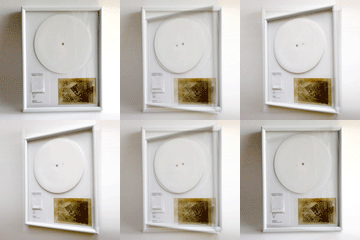
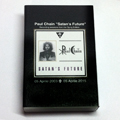
This recording is the documentation of the audio installation conceived for Sound Corner 21 / Auditorium Parco Della Musica, Roma, set from 01 to 30 April 2015. It's based on the ceramic sound object of "Satan's Future", contained in the conceptual edition called "dying edition", published by RMEDL in summer 2015, conceived to pay tribute to the opera of the artist Paul Chain and his personal eschatological research, to his philosophy of death or violet magic.
Paul Chain (1977 - 05 April 2003) declares his artistic death on April 05 2003. Following the suggestions left by the author, who strongly believes that the hidden power of these recordings should be left to die, until its consumption, everything involved in the related Dying Edition is designed to die. The "dying edition" represents the conceptual interment of this artistic body, its final grave.
The source of this limited edition ceramic record is designed to be consumed by its playing. The process of playing the ceramic record will consume the engraved sound waves, from time to time. Slowly the sound waves will disappear, untill only mute ash will remain. This audio recording is the direct documentation of various playing of the ceramic record on turntable, synthesized in three parts. "Satan's Future" was originally selected by Paul Chain for his "Relative Tapes" private archive, courtesy by Marco Melzi, Minotauro Records.
Akusmata Sound Festival | 11. - 15.10.2016 | Sound Gallery Akusmata will celebrate its five year anniversary with the Akusmata Sound Festival. This five-day festival presents a broad spectrum of new aural expression. ASF's program includes performances from Norway, Denmark, Russia and Italy. Italian Radical Matters Editions/ Label brings to Helsinki the doom metal alchemist Paul Chain with a sound installation.
Artistic directors of the festival are Petri Kuljuntausta and Kenneth Kovasin.
Akusmata is also the first sound art gallery in Finland since 2011.
Akusmata art gallery it is directed by Petri Kuljuntausta, a composer, musician, sound artist and author of three important books on electronic music and sound art. In close collaboration with natural scientists his research it's developped in the field between art and science. The most extreme musical environment for Kuljuntausta's music is Saturn's moon Titan. When Cassini-Huygens spacecraft (Titan-IVB/Centaur) started its journey in 1997 from Kennedy Space Center, United States, his composition Charm of Sound was inside the Huygens probe of Cassini-Huygens spacecraft, stored on the CD-rom. When Huygens probe reached its destination on Friday January 14, 2005, Kuljuntausta's Charm of Sound landed on the ground of Titan after travelling seven years and four billion kilometres through Space.
Format: White C-40 Single side.
Edition: Limited to 25 hand numbered copies.
Source: Ephemeral sound object, ceramic record.
Running time: 17':00''
Year: 1981 - 2016.
Cassette Tape description:
This recording is the documentation of the audio installation conceived for Akusmata Sound Festival | 11. - 15.10.2016 | Akusmata Sound Art Gallery. It's based on the ceramic sound object of "Satan's Future", contained in the conceptual edition called "dying edition", published by RMEDL in summer 2015, conceived to pay tribute to the opera of the artist Paul Chain and his personal eschatological research, to his philosophy of death or violet magic.
Paul Chain (1977 - 05 April 2003) declares his artistic death on April 05 2003. Following the suggestions left by the author, who strongly believes that the hidden power of these recordings should be left to die, until its consumption, everything involved in the related Dying Edition is designed to die. The "dying edition" represents the conceptual interment of this artistic body, its final grave.
The source of this limited edition ceramic record is designed to be consumed by its playing. The process of playing the ceramic record will consume the engraved sound waves, from time to time. Slowly the sound waves will disappear, untill only mute ash will remain. This audio recording is the direct documentation of various playing of the ceramic record on turntable, synthesized in three parts. "Satan's Future" was originally selected by Paul Chain for his "Relative Tapes" private archive, courtesy by Marco Melzi, Minotauro Records.
RMEDL / K11 | Chthonian Music | THE OFFICIAL REISSUE
Score:
I - Mvndvs [Munth]
Francisco Lopez - field recording, acousmatic re-processing.
Seth Cluett - deep low frequencies sounds
Pietro Riparbelli - distorted organ, mixing
II - Katábasis
pt.I
Christina Kubisch - tuning forks, electromagnetic filtered
sounds recorded with an inductiveheadphone system, cello flageolett.
Francesco Brasini / Sevenguitars - guitars, amplifiers, enviromental feedbacks
Pietro Riparbelli - organ, composition
pt.II
L'Acephale - guitar, drum, voice
Utarm - power electronics, drones
Pietro Riparbelli - composition
pt.III [Epopteia]
Burial Hex - piano and effects
Andrea Marutti - sinth, drones, concrete sounds
Pietro Riparbelli - organ, voices, composition
pt.V
Luciano Maggiore - concrete sounds
Aderlating - concrete sounds, drones
Philippe Petit - concrete turntablism
Andrea Marutti - sinth
Pietro Riparbelli - organ, composition
RMEDL / K11 | Chthonian Music | THE OFFICIAL REISSUE
Reissue of an extremely limited 2010 release (x50 private copies). This multi-dimensional collaborative opera (audio installation and concept album) is a bridge between the conception of sound within the contemporary art scene, post-industrial culture and the avantgarde black metal musical scene. It focuses on creating a dialogic development between radical forms of concrete music, unorthodox sounds, conceptual arts and experimental recording practices of acoustic phenomena.
Radical Matters - Editions / Label | SG
Presents the hermetic multidimensional concept album
"CHTHONIAN MUSIC" :
Music composed, played and directed by K11 Pietro Riparbelli
Concept, ideation, site specific project direction, screenplay, score, texts, lyrics, sigils and design of the editions: RM-ED/L | Sandro Gronchi. 2 channels and multi channel audio composition, performing, mixing, mastering and real-time spatialization processing by Pietro Riparbelli. Acoustic installation by Sandro Gronchi and Pietro Riparbelli. Recording sessions: Francisco López, Christina Kubisch, Massimo Bartolini, Seth Cluett, Y.E.R.M.O., Francesco Brasini / Seven Guitars, Luciano Maggiore, Gianluca Becuzzi, Andrea Marutti, Philippe Petit , Deadwood, Burial Hex, Aderlating, Utarm, Nordvargr, L'Acephale. This conceptual album is a 2 channel stereo hi-fi transposition of a related site specific multi-channel acoustic installation set, based on the sound spatialization system I.M.E.A.S.Y, both developped from the hermetic multidimensional sound art project Chthonian Music, conceived by RMEDL to be performed in an ancient Etruscan hypogeum sited in Cecina (Italy), during the spring solstice (Ante Diem Duodecimum Kalendas Apriles) within the programmatic-conceptual event "Metasound – Independent Curatorial Experiences in ntemporary Art: from the object up to the event: sound art, multimedia and practice of the art of listening",an hypermedial site-specific project, cured by SG as RMEDL, installed within the archaeological park of Cecina, in the core of the ancient Tuscia.
This conceptual album and the related audio installation are musically composed by Pietro Riparbelli / K11 who playing organ, voices, drum and directis the recording sessions of the acoustic sources produced by the previous mentioned artists, expecially conceived by the authors for this project. This multidimensional collaborative opera is a bridge between the conception of sound within the contemporary art scene, the postindustrial culture and the avantgarde black metal musical scene, focusing on creating a dialogic development between radical forms of concrete music, unorthodox sounds, conceptual arts and experimental recordings practices of the acoustic phenomenas.This project is based on the study of the territory where Cecina stands today, already known in Etruscan age with the name of Kaikne or Kaikna and was inhabited in Roman times, when an imperial personality, the consul Albino Cecina who was a descendant of an ancient Etruscan family that came from Volterra (Velathri), ordered the construction of a villa, the ruins of which are still visited in San Vincenzino.
The surrounding area of Cecina, knew a long period of decline, which began with the decline of the Etruscan civilization and marked during the Roman domination. However in medieval times the name of the Tuscan town was quoted by Dante Alighieri (Inf. XIII, 7). The peculiar state of re-veiling of the historical roots of Cecina town, began in the Roman construction plant of the Albini Villa by the department of archaeological sciences of the University of Pisa (in this contest stands the discovery of a headless statue in Egyptian alabaster that represents Isis). It becomes the right condition for the staging of meta-curator project Metasound through which a witness is shown, though as a part of a state of the art research on aesthetic trans-operative promoting by RM-ED/L. The choice of the roman cistern and its adjacent mysteric tunnels, as the core of the catabasis experience intrinsec in the concept of Chthonian Music. and as sound-chamber of the related acoustic installation, comes from the study on the symbolic meaning of places of worship, that was developed in Etruscan age - civilization that first settled in the adjacent grounds to the Cecina river. The re-veiling of the etruscan settlement, roman villa and medioeval cemetery, in the small park of San Vincenzino, opens to the possibility of considering the reading of the archaeological sites in their likely original function of sacred hypogeum. The cavity of the cistern, thus, becomes a possible reuse of an earlier site of Etruscan origine, with a more likely symbolic function of a place consecrated to the worship of Chthonic Deities. Demeter-Persephone (Phersipnai) was the goddess which was based the religion of the Mysteries, imported by the Etruscans in Italy.
Kidnapped by Hades and carried in the realm of the underworld, becaming the queen of the hell through his ritual death. Demeter, the goddess of the earth got that Persephone / Phersipnai reigned during the winter months and in the remaining months could return to earth, whose myth is the awakening of the soul and its cyclical path of death and transfiguration. Delving into the dark recesses of the earth, meant to open a gate to a supernatural dimension. Tunnels and mazes of paths represented the symbolic difficult journey of the soul towards a higher life. Exit from the bowels of the land, from the darkest recesses of the earth and the human soul, represents the rebirth of the soul to a higher level of living. The annual return of Phersipnai on earth among the living, coincided with the beginning of spring, and on this occasion were celebrated the Lesser Mysteries, or the second Birth. On this occasion, wizards with snakes twisted on the arms, moved at the flickering light of torches in long orgiastic processions (Nuktélia) that ended with a search of the queen Phersipnai.Hetrvria Hermetica.
Audio Score:
Score:
I - Mvndvs [Munth] Francisco Lopez - field recording, acousmatic re-processing. Seth Cluett - deep low frequencies sounds Pietro Riparbelli - distorted organ, mixing
II - Katábasis
pt.I Christina Kubisch - tuning forks, electromagnetic filtered
sounds recorded with an inductiveheadphone system, cello flageolett. Francesco Brasini / Sevenguitars - guitars, amplifiers, enviromental feedbacks Pietro Riparbelli - organ, composition
pt.II L'Acephale - guitar, drum, voice Utarm - power electronics, drones Pietro Riparbelli - composition
pt.III [Epopteia] Burial Hex - piano and effects Andrea Marutti - sinth, drones, concrete sounds Pietro Riparbelli - organ, voices, composition
pt.V Luciano Maggiore - concrete sounds Aderlating - concrete sounds, drones Philippe Petit - concrete turntablism Andrea Marutti - sinth Pietro Riparbelli - organ, composition
Blind Cave Salamander | Pietro Riparbelli / K 11
THE NIETZSCHE FABRIK SESSIONS / TRANSMISSION
In June 2008, Blind Cave Salamander was invited to take part in the Torino World Design Capital festival presenting a site specific performance to be staged on the roof of the Nietzsche Fabrik workshop and incorporating sounds from the local machines, smitheries and carpenters at work. The material on this album is the live recording of the in-studio rehearsal for this performance as then edited and reworked by Marco Milanesio. The same material has since been broadcasted and re-recorded in a unique instrumental transcommunication action, using FM and SW radio signals, by Pietro Riparbelli, inside the Etruscan necropolis of the ancient Kysra. In this way taking the Salamander back underground. In some ways this record displays a possible sound-path within its aural mutations.
Blind Cave Salamander are:
Fabrizio Modonese Palumbo
Paul Beauchamp
Julia Kent
Marco Milanesio
La sutura coronale del cranio presenta ( cosa che sarebbe anzitutto da verificare, ma accettiamola pure) una stretta somiglianza con la linea fitta e sinuosa che la punta di un fonografo inscrive nel cilindro ruotante della apparecchiatura. Che cosa accadrebbe se ingannassimo quella punta e, invece di ricondurla lungo la propria traccia, la portassimo su una via che non è la traduzione grafica di un suono, ma di una cosa che esiste di per se, in maniera naturale, e – bene, diciamolo pure, che fosse (per esempio) proprio la sutura coronale? - : dovrebbe nascere un suono, una sequenza di suoni, una musica…
The coronal suture of the skull bears a close resemblance (this should be verified but let's assume it's true) to the thick and sinuous line inscribed by the stylus of a phonograph on the rotating cylinder. What would happen if we were to cheat that stylus into moving along a different and unusual path, one that is not the graphical translation of a sound but rather something that exists in its own right, naturally, and - well, let's go ahead and say it, something like the coronal suture itself (for example)?-: The result should be a sound, a sequence of sounds, a certain music...
Noise gestalt music. A multidimensional unedit concept album realized with 12 pulsing sculptures of sound layers and hypercinetc ambient drone, produced by Kinetix (Gianluca Becuzzi). A very special edition arranged in a jewel case, composed as 4 different inserts and 2 different possibles front-covers.
Ttrack list:
I - II - III - IV - V - VI - VII - VIII - IX - X - XI - XII
Full lenght: 42:00 min.
Sounds: Gianluca Becuzzi
Visual: ESA (Luigi Turra)
sh Electro-Industrial Concretism from Pietro Riparbelli. Beating, Pulsing, Rumbling Cinematic noise of today! Live and Studio sessions for a powerfull album inspired by the themes of the conflicts. Exclusively based on ambient and concrete sounds manipulations. Special guest Radical Matters: sound sources and background noise sessions. Pecial Tracks: 2 re/de-mix tracks releasd by ECHRAN (Fabio Volpi also know for is work with OTO LAB) and by Gianluca Becuzzi [KINETIX], and another one in collaboration with the cyberdeviant declamations of Kenji Siratori.
Ttrack list:
1. Disorder
2. A Possible Horizon
3. Unexpected (live)
4. Noise
5. Resume (live)
6. I Will Arrive
7. To Seek
8. Anodine (r-mix version by Echran)
9. Digital Curse (featuring Kenji Siratori)
10. Ts (d-mix version by Gianluca Becuzzi)





 REQUEST INFO >>